
Sliding Windows for HDB, Condo & Landed Homes in Singapore
Sliding windows are the most widely used window type in Singapore homes. Two or more glass panels glide sideways along a track, so nothing swings in or out and no space is lost inside the room or on the parapet. They are also the most affordable window mechanism available, with fewer moving parts than casement or top-hung systems. At Grilles N Glass, sliding window frames start from $17 psf in silver mill finish and $19 psf powder coated, supplied and installed. We are a BCA-registered, HDB-licensed contractor and have fitted sliding windows in hundreds of HDB flats, condominium units and landed homes over the past decade.


Why Singapore Homeowners Choose Sliding Windows
- They need no clearance to open. Because the panels travel sideways rather than swinging outward, sliding windows work in places where nothing else will — corridor-facing openings, narrow service yards, and rooms where a swinging panel would foul a fan, a clothes rack or an air-con ledge.
- They are easy to operate and easy to clean. A single push slides the panel open, which suits elderly family members and children. Most panels lift out of the track, so both faces of the glass can be cleaned from inside the flat — a real advantage on high floors where reaching the outer face is otherwise impossible.
- They are the budget-friendly choice. A simple track-and-roller system costs less to fabricate and install than hinged alternatives, so replacing an entire flat’s worth of windows stays affordable.
- They accept screens and grilles cleanly. With no external protrusion, insect screens, invisible grilles and aluminium window grilles all mount without interfering with the opening action.
What are the drawbacks of sliding windows?
Two, and it is worth knowing them before you decide. First, the tracks sit at the base of the frame and can collect rainwater and debris if they are not cleared occasionally — a drained track profile and a quick wipe every few months solves this. Second, the panels overlap rather than compress against a seal, so sliding windows do not block noise as tightly as a casement window does. For a flat facing an MRT line or a main road, we would usually recommend laminated or double-glazed glass, or a casement system in the bedrooms.
Sliding vs Casement Windows: Which Suits Each Room?
Most homeowners replace like for like — sliding frames get sliding frames — simply because it is the path of least resistance. It is worth pausing on the decision, because the right answer usually differs from room to room within the same flat.
Sliding | Casement | |
Opening action | Panels glide sideways on a track | Panels swing outward on side hinges |
Max panel width (HDB) | Up to 1200mm | Up to 700mm |
Space needed to open | None | External clearance for the swing |
Ventilation | Around 50% of the opening on a 2-panel unit | Close to the full opening |
Noise and rain sealing | Moderate — overlapping panels | Better — compresses against a seal |
Corridor use | Permitted | Not permitted |
Cleaning | Panels lift out; both faces reachable from inside | Harder to reach the outer face |
Relative cost | Lowest of all window types | Higher — requires stainless steel friction stays |
Living room
Sliding, in most cases. Living room openings are wide, and a 3-panel or 4-panel slider spans them with fewer vertical frame members interrupting the view than an equivalent run of casement panels. If your living room faces a busy road, upgrade the glass rather than switching mechanism.
Bedrooms
This is the one room where the answer genuinely varies. If the bedroom faces the prevailing breeze and you want maximum airflow, casement scoops more air in. If the bedroom faces afternoon rain, or sits on a high floor where you want to clean from inside, sliding is the more practical choice. Sliding is also the safer option in a child’s room, since there is no outward-swinging panel.
Kitchen and service yard
Sliding, almost without exception. Kitchen and service yard openings are usually narrow and busy — drying poles, racks, a sink below the sill. A swinging panel gets in the way of all of it, and a sliding panel does not. Sliding windows also let you open just half the opening while cooking, which helps with extraction without letting rain in across the whole width.
Corridor-facing windows
Sliding only. Casement windows cannot be used along HDB common corridors, because an outward-swinging panel obstructs the walkway. If your existing corridor windows are sliding, they must stay sliding.
Bathrooms
A small 2-panel sliding window works well where the opening is wide enough. For narrow bathroom openings, a louvre window usually gives better continuous ventilation with the panel partly open.
Can I change from casement to sliding in an HDB flat?
Not automatically. HDB requires replacement windows to preserve the building’s external appearance, and for flats handed over from 1 July 2007 onwards, new windows must match the original colour, proportion and type. Changing the mechanism needs specific approval. Send us your unit details and we will tell you what is permitted for your block before you commit to a design.
Choosing Your Panel and Track Configuration
The number of panels determines how much of the opening you can actually open, and the number of tracks determines how the panels stack when they slide.
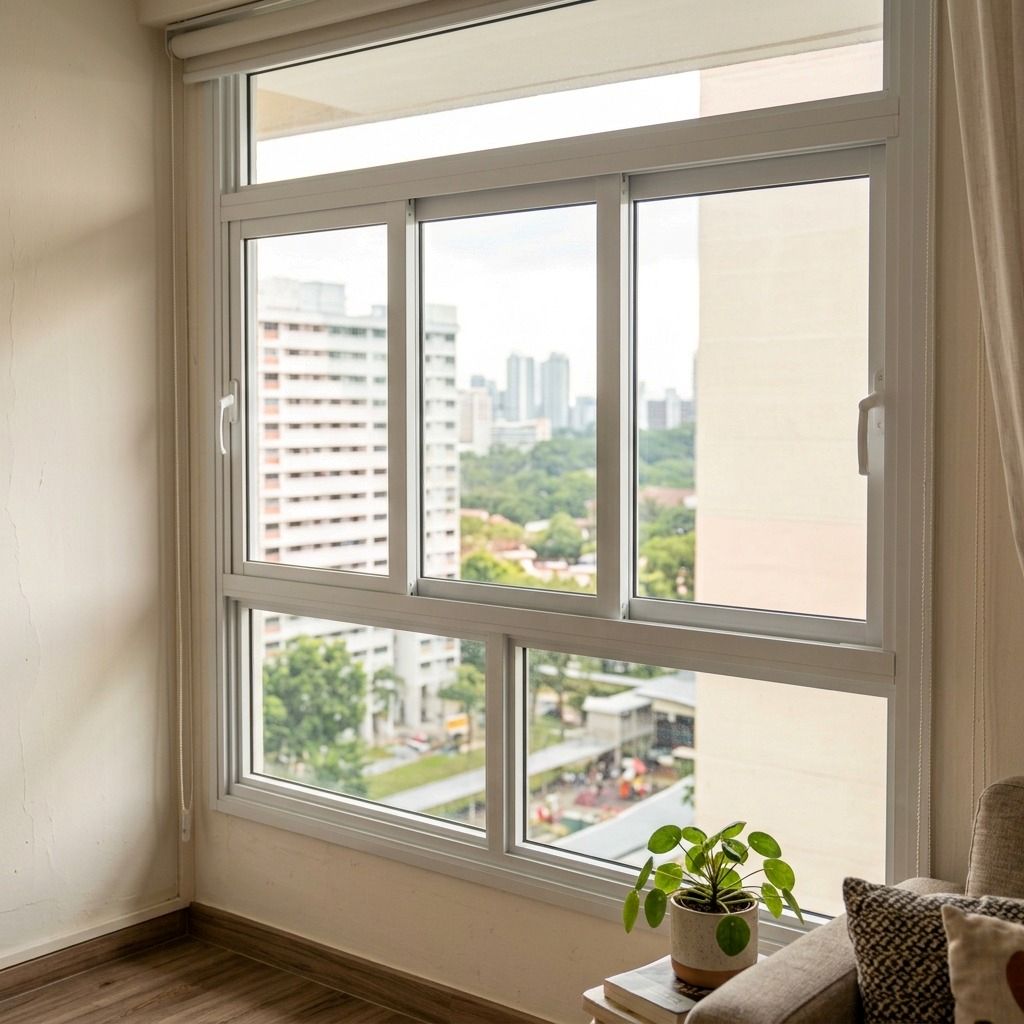
Panels. On a standard 2-panel window, one panel slides behind the other, so you get roughly 50% of the opening. A 3-panel window on two tracks gives you around two-thirds. Bedrooms and kitchens typically take 2-panel units; living room openings usually take 3 or 4 panels. Under HDB guidelines each sliding panel can run up to 1200mm wide, which is why sliders suit wide openings that would otherwise need several casement leaves.
Tracks. One track per panel gives you the maximum possible opening, because every panel can stack behind the others. The trade-off is frame depth — more tracks means a wider, heavier frame and a thicker sightline. Two tracks is the practical standard for most HDB openings; three tracks is worth it where ventilation matters more than the frame profile, such as a living room that relies on cross-breeze.
Rollers. Ask about these specifically. Stainless steel rollers carry the panel weight without deforming, whereas cheaper nylon or plastic rollers flatten and crack over time, which is the single most common cause of a window that will not slide. All our sliding windows are fitted with stainless steel rollers as standard.
Safety hardware. HDB and BCA require sliding windows to be fitted with self-locking safety devices and stoppers that prevent a panel jumping off its track, along with grade 304 stainless steel rivets that resist corrosion in our climate. These are not optional extras — they are part of every compliant installation and are included in our work.
Frame Colours and Glass Options
Frame finishes
Finish | Price | Notes |
Silver mill finish | $17 psf | The original aluminium colour. Common in older flats. |
Powder coated | $19 psf | Any colour to your requirement. Adds a protective layer against corrosion. |
White powder-coated frames are the most popular choice in Singapore, and for good reason — white matches the vast majority of HDB block façades, keeps interiors looking bright, and does not show the fine dust that settles on darker frames. Dark grey and bronze have become common in condominium and landed projects where the frame is meant to read as a design feature rather than disappear.
Does HDB restrict my window colour?
Yes, and it catches homeowners out. For flats handed over from 1 July 2007 onwards, replacement windows must match the colour and proportion of the original windows, because HDB maintains the uniform appearance of each block’s external façade. Older flats generally have more latitude. We check your block’s requirement as part of the permit application, so you find out before fabrication rather than after.
Glass options
All panels below are 5mm thick, except laminated frosted glass at 6.38mm.
Light or Dark Grey
Light Brown
Clear
Green or Blue
Frosted
Laminate Frosted Glass
- Light or dark grey — cuts glare and solar heat gain. Worth considering for west-facing rooms.
- Clear — maximum light and view. The default for living rooms and bedrooms.
- Frosted — obscures the view while passing light. Standard for bathrooms.
- Light brown — warmer tint, similar heat performance to grey.
- Green or blue — tinted feature glass.
- Laminated frosted (6.38mm) — an interlayer bonds two glass sheets, so the pane holds together if broken. Better privacy, better sound reduction, and the safer choice for low-sill openings or homes with young children.
If noise is your main concern, ask us about laminated or double-glazed options rather than simply upgrading the tint.
Sliding Window Prices in Singapore
Sliding windows are priced per square foot of the finished window, not per unit — so the cost depends on the size of your opening rather than the room it sits in.
Our rates: $17 psf for silver mill finish, $19 psf for powder coated, supplied and installed.
Worked example
A typical HDB living room opening is around 8 feet wide by 4 feet high — 32 square feet.
Silver mill @ $17 psf Powder coated @ $19 psf Living room, 3-panel, 32 sq ft $544 $608 Bedroom, 2-panel, 20 sq ft $340 $380 Kitchen, 2-panel, 15 sq ft $255 $285
To estimate your own flat, measure the width and height of each opening in feet, multiply for the square footage, add them together, and multiply by the rate. As a rough guide, a 4-room HDB flat has somewhere between 115 and 130 square feet of sliding window area across the living room, three bedrooms, kitchen and service yard.
What else should I budget for?
- HDB renovation permit — a $100 application fee applies to window replacement works. We prepare and submit the application on your behalf.
- Removal and disposal of your old frames and grilles.
- Window grilles, if you are adding or replacing them at the same time. Quoted separately based on design and material — doing both together saves a second round of scaffolding and permit work.
- Glass upgrades — laminated or double glazing carry a per-square-foot uplift over standard 5mm.
- Access — units requiring external access equipment may carry an additional charge.
Is it cheaper to replace all my windows at once?
Usually, yes. A single mobilisation, one permit application and one installation team across the whole flat costs less per window than replacing them one at a time over several years — and a full replacement resets the clock on every frame simultaneously, which matters at resale.
PS : All prices on this page are estimates for planning purposes and are current as of publication. Final pricing depends on exact measurements, panel configuration, glass specification, site access and the condition of your existing openings. We provide a firm written quotation after a site visit, at no cost and with no obligation.
How to Order Sliding Windows
Share Your Requirements
Provide us the details (Floor Plan, Number of Rooms, etc)
Get Estimate
We’ll give you a Quotation based on type of Window you like
Schedule the Installation
Pay a small advance & fix the date and time of installation
Setup & Installation
Onsite preparation & installation by us. Settle remaining payment and start of Warranty

We offer direct factory price with latest designs and excellent workmanship