
Aluminium Casement Windows Singapore
A casement window is hinged along one edge and swings open like a door, held in position by a friction stay and secured with a lever handle. You may also see them called hinged windows, side-hung windows, swing-out windows or push-out windows — all the same thing. Casement is the type to choose when you want the fullest possible opening, the tightest seal against rain and noise, and an unobstructed view with no track or overlapping panel in the way. Grilles N Glass supplies and installs aluminium casement windows and top hung windows across Singapore for HDB flats, condominiums and landed homes, as a BCA-registered and HDB-licensed contractor.

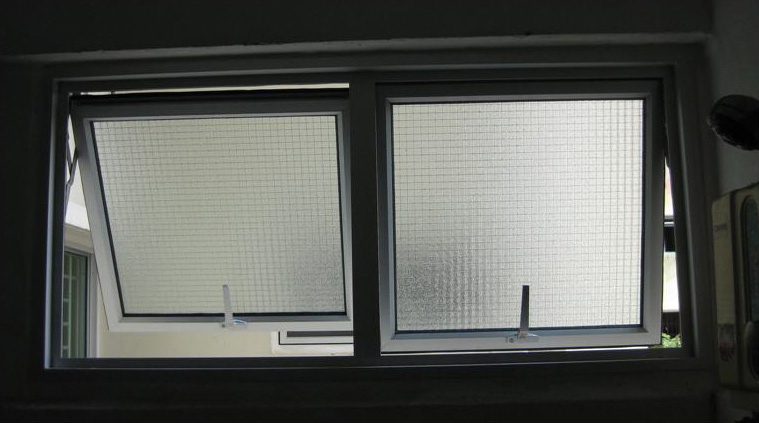

Types of Casement Windows
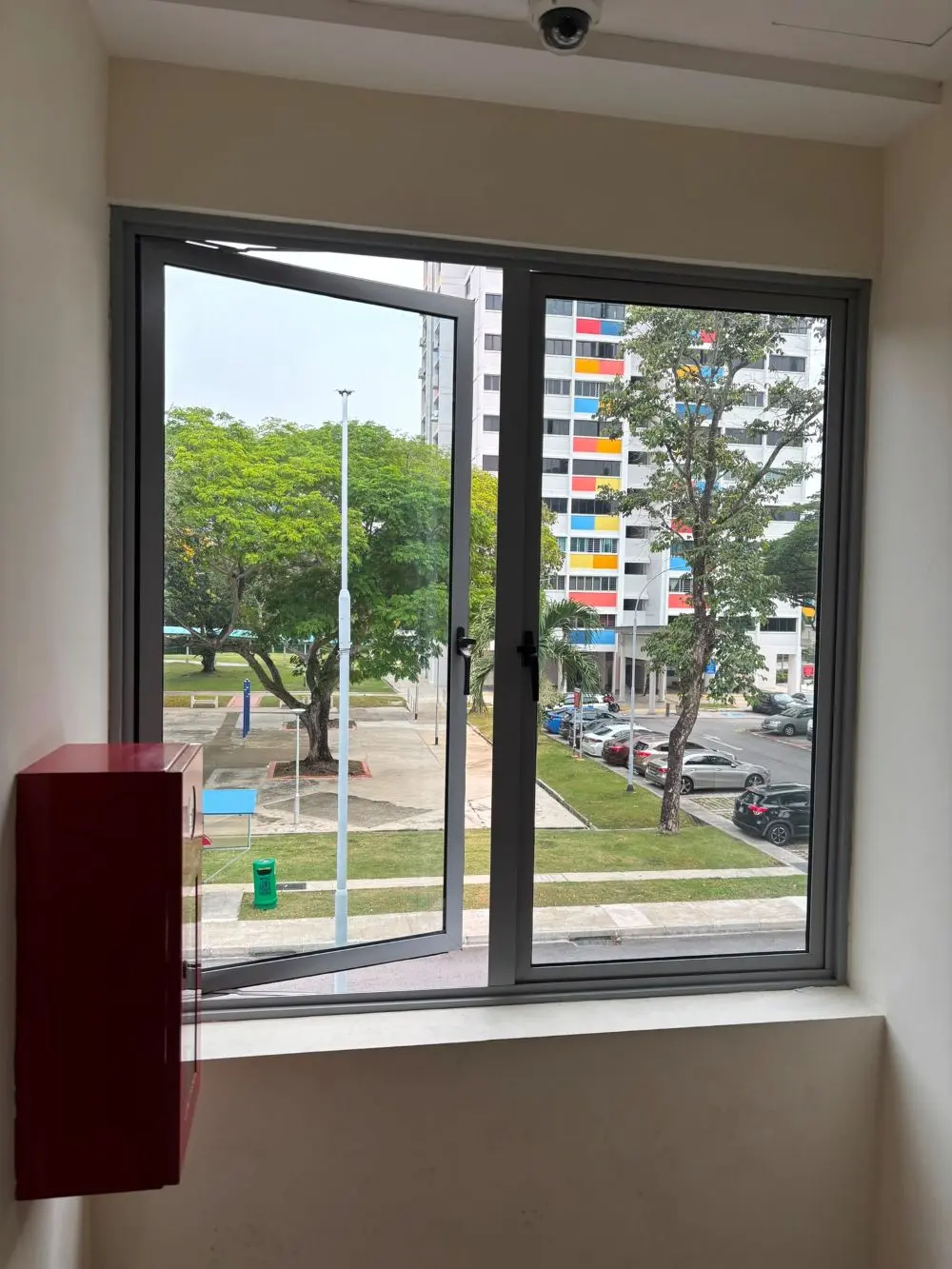
Side-hung casement
The standard configuration. Hinges run down one vertical edge and the panel swings outward, opening to 90 degrees or more. Used in bedrooms, living rooms and any opening where you want maximum airflow and a clear view.
Top hung (awning)
Hinged along the top edge, so the panel projects outward from the bottom. Covered in full in the next section — this is the type most Singapore homeowners end up asking about.
Combination casement and top hung
A very common HDB arrangement: one or two side-hung panels for the main opening, with a smaller top hung panel above or beside them. The top hung panel handles day-to-day ventilation, so the main window stays shut most of the time. Fewer opening cycles on the main panel means less wear on its friction stays.
Single vs multi-panel casement
HDB restricts a single casement leaf to a maximum width of 700mm. Wider openings are therefore split into two, three or four panels rather than one large leaf. This is the main practical difference from a sliding window, where a single panel can run up to 1200mm — and it is why very wide openings often end up as sliders.
Top Hung Windows (Awning Windows)
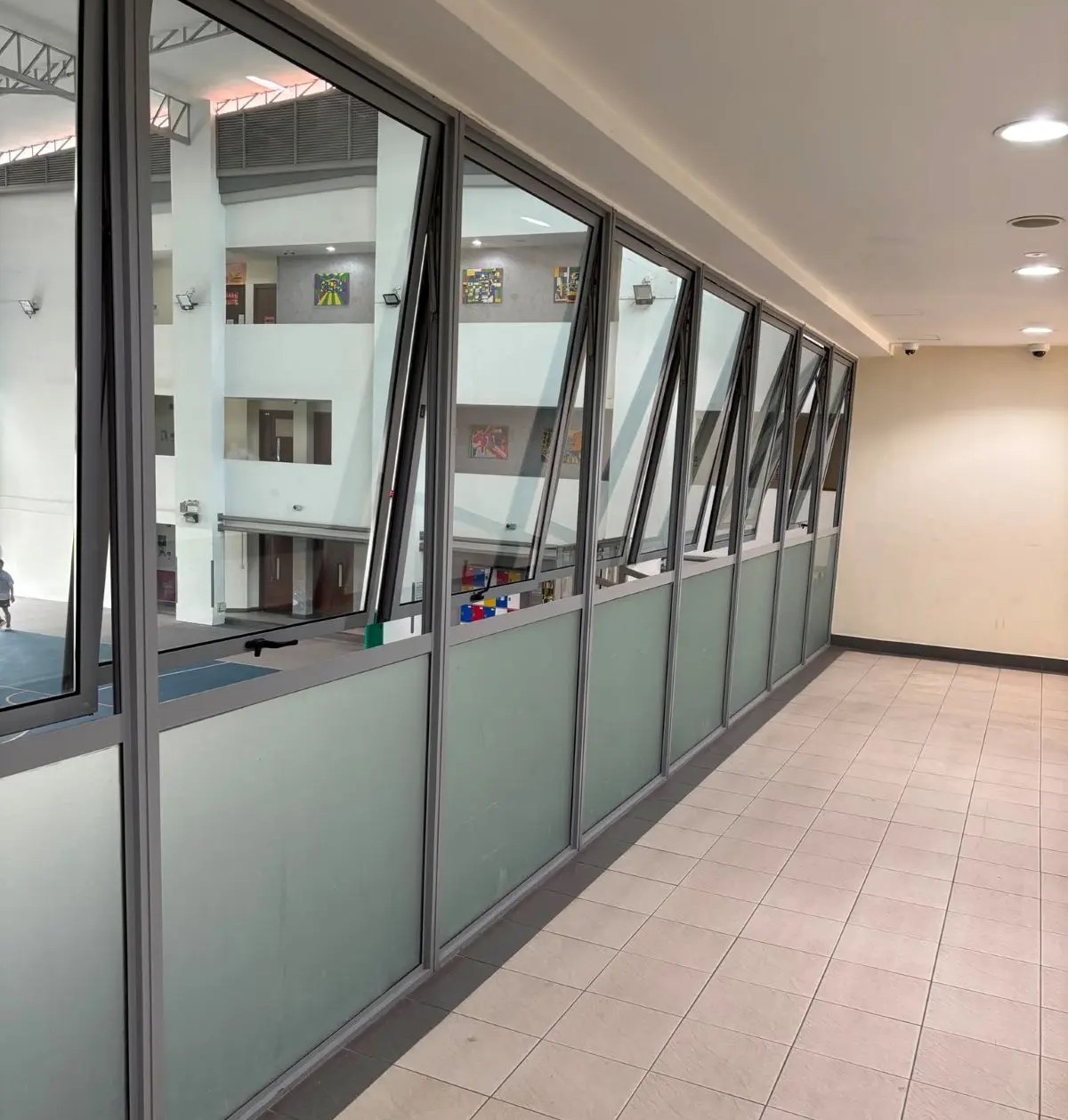
A top hung window is hinged at the top of the outer frame, so the glass panel pivots outward from the bottom edge. In Singapore they are also called awning windows, and that name describes exactly what makes them useful: the open panel forms a small awning over the gap.
Why top hung windows suit Singapore’s climate
You can leave them open in the rain. This is the whole argument. Because the panel angles outward and downward from the top, rain runs off the outer face and away from the opening rather than through it. During an afternoon thunderstorm, a top hung window keeps ventilating while every other window in the flat has to be shut.
They ventilate without a full opening. Fitted above or alongside a main casement, the top hung panel lets air move through continuously while the main window stays closed and locked — useful for security, and for rooms you leave unattended.
They work in small, high openings. Bathroom, toilet and kitchen openings are often narrow strips set high in the wall. A side-hung panel there is awkward to reach and swings into the clothesline or the air-con ledge. A top hung panel opens with a short push and clears everything.
Where top hung windows are used in HDB flats
Most commonly the toilet and bathroom, where the opening is small, privacy matters and continuous ventilation is needed to keep the space dry. Also frequently seen in kitchens, above service yard openings, and as the upper panel of a combination window in bedrooms.
Top hung vs side-hung casement — which should you choose?
Top hung (awning) | Side-hung casement | |
Hinge position | Top edge | One vertical edge |
Opening angle | Limited — typically 30–45° | 90° or more |
Airflow | Moderate | Maximum |
Usable in rain | Yes | No |
Suits small, high openings | Yes | Awkward |
View when open | Panel sits in the sightline | Fully clear |
Cleaning the outer face | Reachable from inside | Reachable from inside |
Choose top hung for toilets, bathrooms, kitchens and anywhere you want ventilation in wet weather. Choose side-hung for bedrooms and living rooms where airflow and view matter more. In a typical HDB flat you will want both, and there is no cost penalty for mixing them in one order.
Are top hung windows allowed in HDB flats?
Yes. Top hung windows are permitted throughout HDB flats and are the standard solution for toilet and bathroom openings. Like all casement-type windows they must be fitted with compliant friction stays and installed by a licensed contractor. The one restriction that catches people out applies to common corridors — see the safety section below.
Why Choose Casement Windows
The best seal of any window type. When you turn the handle, the panel compresses against a gasket around the full perimeter of the frame. Nothing overlaps and nothing slides. That single mechanical fact drives every other advantage: casement windows are the most resistant to wind-driven rain and water infiltration of the common window types, and they block noise better than any sliding equivalent. It is why casement is the base for almost every soundproof window installation in Singapore.
The fullest opening. Opening to 90 degrees or more, a casement window gives you close to the entire opening as usable ventilation area. A two-panel sliding window of the same size gives you roughly half.
A completely clear view. No central track, no overlapping panel, no meeting rail across the middle of the glass.
Secure locking. The lever handle draws the panel into the frame and locks it there, with the friction stay holding the panel rigid. There is no panel to lift off a track.
Clean lines for window treatments. With a flush lever rather than a projecting winder, curtains and blinds hang naturally against the frame.
What are the drawbacks of casement windows?
Three worth knowing. The 700mm leaf limit means wide openings need multiple panels, so you get more vertical frame members across the view than a slider would give you. The panel swings outward, so it cannot be used where anything sits in the swing path — which rules out common corridors entirely. And casement costs more than sliding, because the stainless steel friction stays and hinges are more expensive hardware and take longer to install.
Which Rooms Suit Casement Windows?
Toilets and bathrooms
Top hung, almost always. The opening is small and set high, privacy is required, and the room needs to stay ventilated even in wet weather to control damp and mould. Frosted or laminated frosted glass in a top hung panel is the standard HDB toilet window specification.
Bedrooms
Side-hung casement is the strongest choice here. It catches the prevailing breeze at an angle rather than letting it pass across the opening, it seals tightly against traffic noise at night, and the full opening helps a room with only one external wall.
Kitchens
Depends on the opening. A narrow high strip takes a top hung panel. A wider opening above the sink or counter is often better as a slider, because a side-hung panel that swings outward is hard to reach across a worktop. We will tell you which way your specific opening should go.
Living rooms
Casement works well where the opening is moderate. On a very wide living room opening the 700mm leaf limit means several panels and several frame members in the view — worth comparing against a three-panel slider before you decide.
Common corridors — not permitted
Casement and top hung windows cannot be installed on HDB common corridor openings, because an outward-swinging panel obstructs the walkway and creates a hazard for people passing. Corridor windows must be sliding. If your flat has corridor-facing openings, they stay sliding regardless of what you fit elsewhere.
Casement Window Prices in Singapore
Casement windows are priced per square foot of finished window, so the cost follows the size of your opening rather than the room it sits in. Casement carries a higher rate than sliding, because it requires grade 304 stainless steel friction stays and hinges rather than simple rollers, and takes longer to install.
Our rates: $19 psf in silver anodised finish, $21 psf powder coated, supplied and installed.
Worked example
A standard two-panel HDB bedroom casement window is around 20 square feet. A living room casement runs closer to 32 square feet. A toilet top hung panel is typically 5 to 7 square feet.
Opening Approx. area Silver anodised @ $19 psf Powder coated @ $21 psf Bedroom, 2-panel casement 20 sq ft $380 $420 Living room, 3-panel casement 32 sq ft $608 $672 Toilet, top hung 6 sq ft Minimum charge applies Minimum charge applies
To estimate your own, measure each opening in feet, multiply width by height, add the openings together and multiply by the rate.
A note on small windows. Per-square-foot pricing works properly on a full-flat order. On a single small panel — a toilet top hung, for example — the fabrication, hardware, permit and installation visit cost the same as they would for a large window, so a minimum charge applies rather than a straight psf calculation. Ask us for the figure when you enquire.
What else should I budget for?
- HDB renovation permit — a $100 application fee applies to window replacement works. We prepare and submit the application for you.
- Removal and disposal of your old frames and grilles.
- Window grilles, quoted separately by design and material.
- Glass upgrades — laminated and double-glazed carry a per-square-foot uplift.
- Access equipment, where external access is restricted.
Is casement more expensive than sliding?
Yes, by $2 per square foot — our sliding windows are $17 psf silver and $19 psf powder coated. The gap is hardware, not glass: grade 304 stainless friction stays and hinges cost more than rollers and stoppers, and they take longer to fit. On a 20 sq ft bedroom window that difference is $40. Whether it is worth paying depends on the room — in a bedroom facing a main road, the tighter seal usually justifies it; in a service yard, it rarely does.
PS: All prices on this page are estimates for planning purposes and are current as of publication. Final pricing depends on exact measurements, panel configuration, glass specification, site access and the condition of your existing openings. We provide a firm written quotation after a free site visit, with no obligation.
Panels, Glass and Frame Colours
Panel count. Divide your opening width by 700mm to find the minimum number of leaves. A 1.4m opening takes two panels; a 2.1m opening takes three; wider openings take four or move to a combination design with fixed glass.
Frame finishes. Silver mill finish is the original aluminium colour and matches most older HDB blocks. Powder coating is available in any colour and adds a protective layer against corrosion — white is the most popular choice in Singapore, with dark grey and bronze common in condominium and landed projects.
Glass options. Clear for living rooms and bedrooms. Light or dark grey to cut glare and solar heat on west-facing rooms. Frosted for bathrooms and toilets. Laminated frosted at 6.38mm bonds two sheets with an interlayer, so the pane holds together if broken — the safer option for low sills and homes with children, and better for both privacy and sound.
If noise is your main reason for choosing casement, ask about laminated or double-glazed glass rather than simply tinting.
How to Order Grilles for your Windows
Share Your Requirements
Provide us the details (Floor Plan, Number of Rooms, etc)
Get Estimate
We’ll give you a Quotation by Types of Window you like
Schedule the Installation
Pay a small advance & fix the date and time of installation
Setup & Installation
Onsite preparation & installation by us. Settle remaining payment
Fitting Grilles to Casement Windows
Because a casement panel swings outward, the grille goes on the inside face of the opening — which means the design has to account for two things a sliding window never raises.
Handle clearance. You need to reach and turn the lever with the grille in place. Aluminium grilles are set out from the frame, or the horizontal bars are spaced to leave the handle accessible.
Friction stay travel. The stay arm needs its full range to open the panel. A grille mounted too tight against the frame will stop the window short of its full opening — which defeats the reason you chose casement.
Invisible grilles suit casement particularly well. The stainless steel cables run within the opening and sit clear of the swing path entirely, so you keep the full 90-degree opening and the clear view that made casement the right choice.
Ordering windows and grilles together is worth doing. One contractor, one permit, one installation visit, and the grille is designed around your actual window hardware rather than retrofitted to it afterwards.
HDB Safety Rules and Maintenance
Casement windows carry stricter hardware requirements than sliding windows, because the friction stay is the only thing holding an open panel to the building.
What does HDB require?
Casement and top hung windows must be fitted with grade 304 stainless steel friction stays of at least 2.50mm thickness, and with stainless steel rivets. Using inferior fixings is an offence carrying a fine of up to $5,000 or six months’ imprisonment. Window replacement also requires an HDB renovation permit, which only a BCA-approved contractor registered under the RW01 workhead can apply for on your behalf. Approval generally takes up to seven working days. For flats handed over from 1 July 2007 onwards, replacement windows must match the colour and proportion of the originals.
How do I check my casement windows?
Every six months, in about ten minutes:
- Look at the rivets and screws on the top and underside of each panel — a small mirror helps. They should not be rusty, weeping rust stains, or loose.
- Check the friction stays are firmly secured and not bent.
- Open and close each panel. A window that has become stiff usually means the stay is seizing or the channel is obstructed.
- Check the handle engages fully and holds the panel tight against the frame.
Singapore recorded 41 cases of fallen windows in the first eleven months of 2025. Homeowners hold a duty of care for their windows, and a window that falls due to poor maintenance can bring a fine of up to $10,000 or imprisonment of up to one year.
When does a casement window need replacing?
Stiff stays or a loose handle can sometimes be retrofitted by a licensed contractor. But once rivets are visibly corroded, the frame is warped, water is coming through the frame itself, or the window is past fifteen to twenty years, replacement is the only reliable option — the hardware and the frame reach end of life together, and a retrofit on a corroded frame does not restore the fixing strength that keeps the panel attached.
Casement Window Contractor in Singapore
Whether you need side-hung casement, top hung awning windows, or a combination of both, Grilles N Glass manufactures and installs aluminium casement windows customised to your opening, glass specification and frame colour. We are BCA-registered and HDB-licensed, we handle the permit submission and completion certification, and we install with our own team rather than subcontracting.
We offer direct factory price with latest designs and excellent workmanship